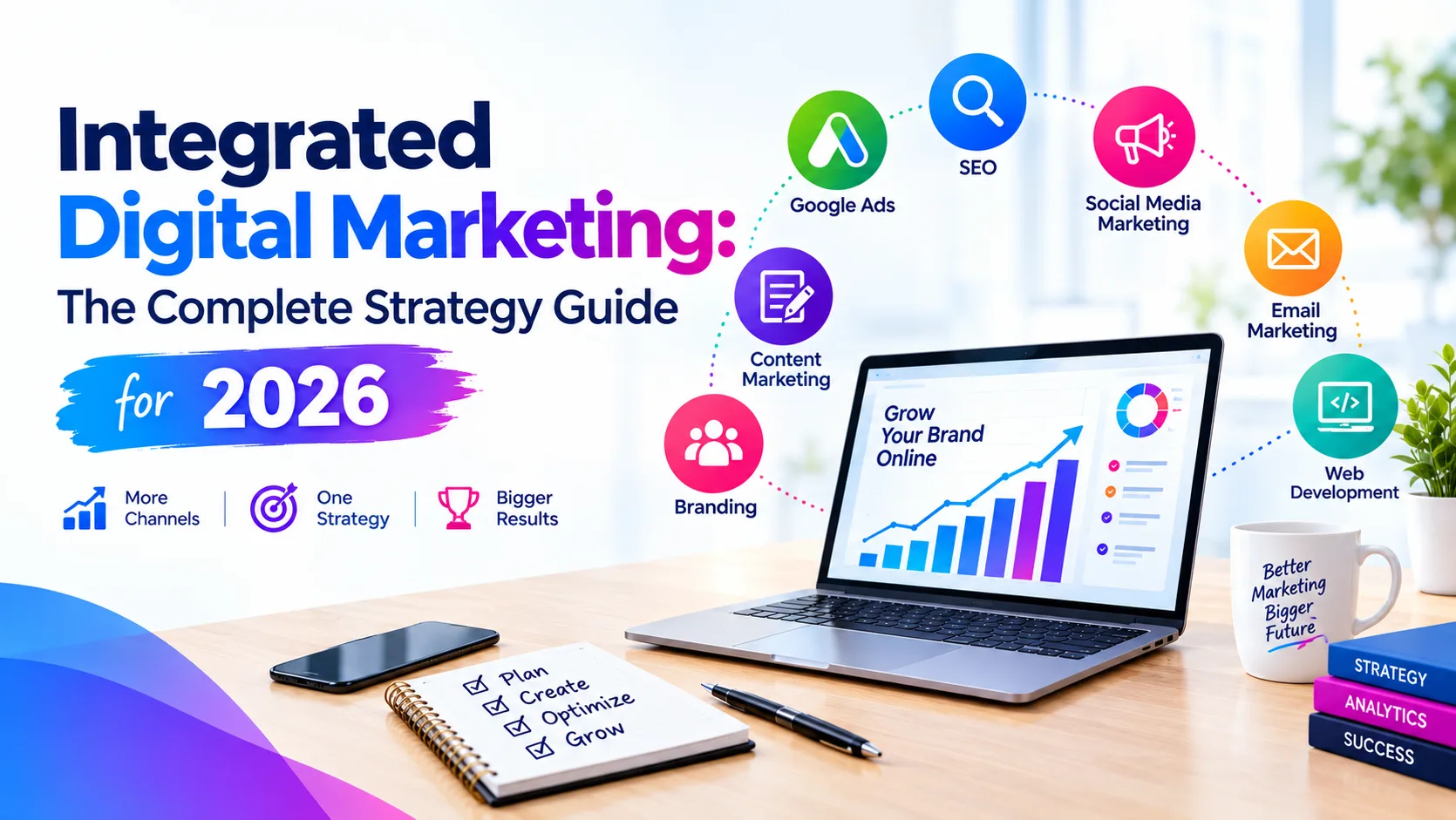
Quick Answer: Integrated digital marketing ensures that each channel supports the others rather than competing for the same customers by combining SEO, PPC, content, email, social media, and marketing automation under a unified strategy, brand messaging, and shared measurement framework. According to the Data & Marketing Association, integrated marketing integrates all communication channels to take a customer from awareness to loyalty, as opposed to a collection of separate initiatives.
What Is Integrated Digital Marketing?
Integrated digital marketing unites all digital channels-search, social media, content, email, and paid media-around a single customer journey, a single brand voice, and a single set of business goals. Integration removes the need for your SEO team, social media manager, and advertising agency to seek separate KPIs.
- One strategy, one calendar – Campaigns, marketing, and content are all designed collaboratively rather than separately by channel.
- One brand voice – Whether a consumer finds you through an email, an Instagram advertisement, or a Google search, your messaging remains the same.
- One measurement system – Revenue and leads are monitored throughout the whole process, not just the last click.
- Channels that compound each other – Social media postings are fueled by SEO content, social media creates audiences for retargeting, retargeting feeds email nurturing, and email completes the cycle back to conversions.
The goal is not to “be everywhere.” It involves making sure you always say the same thing, report to the same dashboard, and address the same audience.
Why Integration Matters More Than Ever in 2026
The way people search has completely changed. Customers no longer go straight from clicking an advertisement to making a purchase; instead, they navigate between Google, YouTube, Instagram, WhatsApp, AI chat assistants, and review sites before making a decision, frequently switching devices in the process.
- AI-powered search is fragmenting discovery. Google’s own guidance on AI features emphasizes rewarding content that demonstrates real expertise and a consistent topical presence exactly what a coordinated content and SEO strategy builds, and what scattered, inconsistent content struggles to earn.
- Rising ad costs are punishing inefficiency. As CPCs climb across Google and Meta, businesses can no longer afford paid channels that don’t share data with organic efforts.
- Attribution is harder, not easier. Privacy changes and multi-device journeys mean single-channel attribution increasingly misrepresents what’s actually driving revenue.
- Buyers expect consistency. A disjointed experience erodes trust faster than it used to, especially in competitive service categories.
Integrated vs. Multi-Channel Marketing: What’s the Difference?
| Aspect | Multi-Channel Marketing | Integrated Digital Marketing |
| Strategy | Each channel runs its own plan | One unified strategy across all channels |
| Messaging | Can vary by platform | Consistent brand voice everywhere |
| Budget allocation | Fixed per channel, rarely reallocated | Dynamic – shifts to whatever’s converting |
| Data | Siloed reports per channel | Shared attribution across the full funnel |
| Team structure | Separate specialists working independently | Cross-functional team aligned on shared KPIs |
| Customer experience | Fragmented, inconsistent touchpoints | Seamless journey from first click to conversion |
| Typical outcome | More impressions, unclear ROI | Lower cost per lead, clearer attribution |
The Core Channels of an Integrated Strategy
| Channel | Primary Role | Best For | Key Metric |
| SEO | Long-term, compounding organic visibility | Sustainable lead flow | Rankings, organic traffic, leads |
| Content Marketing | Authority-building and top-of-funnel education | Trust, backlinks, AI-search citations | Engaged sessions, assisted conversions |
| PPC (Google/Meta Ads) | Fast, high-intent demand capture | Immediate leads | CPL, CPA, ROAS |
| Social Media Marketing | Brand awareness and retargeting audience building | Reach, community, remarketing pools | Engagement rate, CTR |
| Email Marketing & Automation | Nurture and retention | Converting warm leads, repeat business | Open rate, click rate, conversion rate |
| Website/Landing Pages | The conversion layer where all traffic lands | Turning visits into leads | Conversion rate, bounce rate |
| Online Reputation Management | Trust signal that lifts conversion on every channel | Local and service businesses | Review volume, star rating |
How to Build an Integrated Digital Marketing Strategy (Step-by-Step)
1. Set one set of business goals not channel goals. First, decide what your lead, sales, or reservation goals are. Each channel then works backward from that number instead of optimizing for its own vanity metric.
2. Map the full customer journey. From initial awareness (organic search, social discovery) to consideration (comparison content, reviews), conversion (form fill, call, purchase), and retention (email, remarketing), identify each touchpoint.
3. Build one content and messaging hub. To ensure that the message never breaks, core content-such as a pillar page, a case study, or a product explainer-is reused in email, ad creative, social media captions, and SEO.
4. Align budget to the funnel stage, not the channel. While SEO and content provide the long-term organic base that ultimately reduces your cost per lead, use PPC and paid social media to generate short-term demand.
5. Set up cross-channel attribution.Link your CRM, ad networks, and Google Analytics so you can identify which combination of channels-rather than just which channel had the most recent click-actually generated a customer.
6. Create a shared editorial and campaign calendar. A single calendar that displays what is launching, when, and on which channels should be used by all teams, including SEO, social media, email, and paid.
7. Review and reallocate monthly. Integration only works if the budget moves toward what’s converting.
Industry-Specific Integration Playbooks
- Local service businesses (home services, clinics, RTO/legal consultancies): “Near me” intent is driven by local SEO and Google Business Profile optimization; emergency or high-urgency searches are captured by PPC; and reputation management takes over as the main trust signal across all other channels.
- B2B and long sales-cycle businesses: PPC has a smaller, more focused role; LinkedIn and email nurture move leads through a longer decision window; and content marketing and SEO establish authority at the top of the funnel.
- E-commerce and retail: Near-term revenue is generated by paid social media and Google Shopping; cart abandonment is managed by email/SMS automation; and long-term ad dependency is decreased via SEO and content building category authority.
- Education and exam-prep platforms: Practice questions, tutorials, and comparison sites are examples of SEO-driven content that attracts high-intent research traffic; email nurture turns free users into paying students; and social proof is crucial because education purchases require trust.
The Technology Stack Behind Integration
- A central analytics layer (Google Analytics 4) tracking every channel against the same conversion events
- A CRM that captures leads regardless of source and tracks them through to closed revenue
- Marketing automation software that triggers sequences based on behavior across channels
- A shared reporting dashboard that blends channel data into one view instead of five separate logins
In-House Team vs. Agency: Who Should Run Your Integrated Strategy?
| Factor | In-House Team | Integrated Agency |
| Cost | Higher fixed cost (salaries, tools) | Lower fixed cost, scalable retainer |
| Speed to execute | Faster once ramped up | Faster to start, no hiring lag |
| Channel expertise | Depends on team size/budget | Access to specialists across every channel |
| Coordination risk | High if channels aren’t managed by one lead | Built in if the agency runs true integration |
| Best fit | Larger businesses with dedicated marketing leadership | SMBs and mid-size businesses without a full internal team |
Integrated Digital Marketing Strategy for Small Business: What Changes
Small businesses don’t immediately need every channel; they only need the appropriate order. One sponsored channel (Google Search Ads for high-intent categories, Meta for visually-driven ones), local SEO and Google Business Profile (lowest cost, highest local-intent return), and email automation (third after there’s enough traffic to nurture) would be a reasonable place to start. Attempting to run all seven channels concurrently on a limited budget is the most common reason small-business integration attempts stall; depth on two or three coordinated channels performs better than shallow presence on seven.
Integrated Digital Marketing Pricing in India
| Package | Monthly Investment (INR) | What’s Typically Included |
| Starter | ₹25,000 – ₹45,000 | SEO + social media management for 1-2 channels |
| Growth | ₹50,000 – ₹90,000 | SEO + content + PPC + social, shared reporting |
| Enterprise | ₹1,00,000+ | Full-funnel: SEO, PPC, content, email automation, reputation management, dedicated strategist |
Key Metrics to Track
- Visibility: keyword rankings, impressions, share of voice
- Engagement: engaged sessions, scroll depth, content performance
- Conversion: lead rate, cost per lead, booking rate
- Revenue impact: MQL-to-SQL rate, pipeline contribution, customer acquisition cost
- Cross-channel efficiency: blended cost per lead across all channels combined
Common Mistakes That Break Integration
- Running channels in silos – separate agencies or freelancers per channel with no shared reporting
- Inconsistent messaging – different offers or positioning on the website vs. social vs. ads
- Last-click attribution only – starving the channels that built awareness earlier in the journey
- No shared calendar – campaigns launching on different timelines instead of reinforcing each other
- Treating integration as a one-time project – letting channels drift back into silos over time
- No single owner – when everyone is responsible for coordination, no one actually is
Useful SEO & Digital Marketing Resources
Frequent Asked Questions
What is an example of integrated digital marketing?
A business publishes an SEO-optimized blog article, promotes it with a sponsored social campaign, retargets visitors with display ads, and follows up with an email nurture sequence using the same offer and messaging, all of which are monitored in a single dashboard.
Is integrated digital marketing more expensive than running channels separately?
Usually not. Over the course of six to twelve months, integrated tactics usually result in a reduced blended cost per lead since the budget is reallocated to whatever is converting rather than being fixed per channel.
How long does integrated digital marketing take to show results?
Results from PPC and paid social media can be seen in a matter of weeks. Since it usually takes three to six months for SEO and content to get traction, an integrated approach combines the two.
Do small businesses need integrated digital marketing, or is it only for large companies?
Due to their tight resources and inability to pay for the waste of fragmented, disorganized channels, small enterprises frequently gain the most.
What’s the difference between integrated marketing and omnichannel marketing?
Unified strategy and messaging across channels are the main goals of integrated marketing. A smooth experience across those channels is another necessity of omnichannel.
Do I need a marketing automation tool to run an integrated strategy?
Not on the smallest scale, but as cross-channel nurturing sequences go beyond what can be constructed by hand, it becomes urgently imperative.
How do I measure ROI across multiple integrated channels?
Use a single CRM and analytics setup to track leads from initial contact to closed revenue rather than assessing each channel independently. Next, assess the system-wide blended cost per lead.