
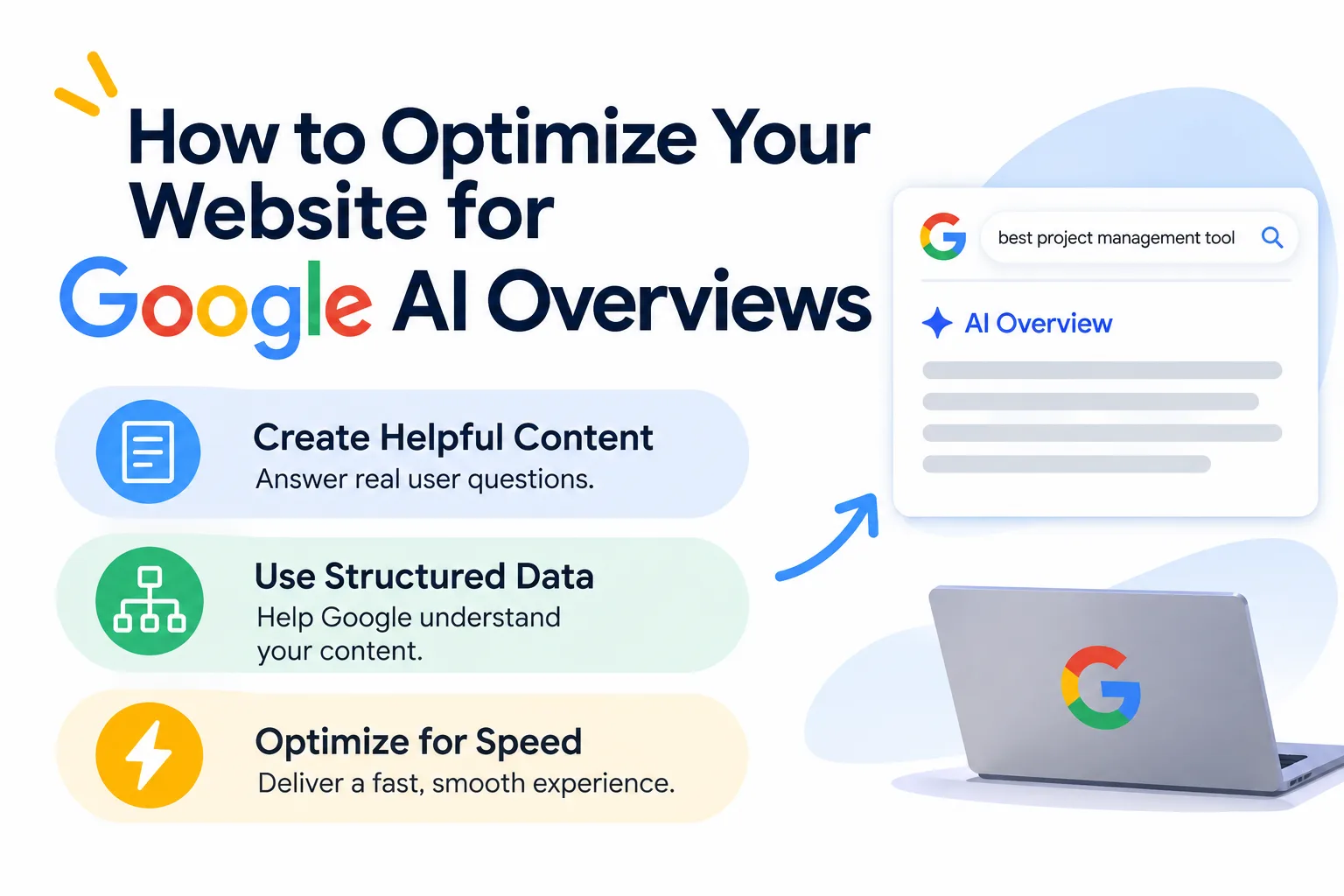
Quick Answer: Make sure your pages are indexable, explicitly address actual questions, demonstrate first-hand knowledge, and employ precise schema, a clear structure, and robust technical SEO in order to optimize for Google AI Overviews. Although no one can ensure inclusion, these actions increase your chances of being taken into consideration as a source.
AI Overviews SEO: What Every Business Owner Should Know
Before they scroll to a single blue link, a lot of individuals now read an AI-written summary at the top of Google. That begs the question, “How do I stay visible when Google answers first?” for a business owner in Delhi, a startup founder in Bengaluru, or a marketer in London.
The truth is that nobody can assure you of a spot in an AI Overview, and you should be wary of anyone who does. According to Google, the same fundamental SEO techniques that improve a page’s performance in standard search also apply to its AI features.
What Are Google AI Overviews?
AI-generated summaries known as Google AI Overviews show up at the top of some Google search results. They provide links to pages where readers can learn more and condense information from multiple sources into a succinct response.
Instead of appearing for straightforward navigational searches like a brand name, they typically show up for complicated, multi-part, or “how do I…” queries. The query, location, language, and Google’s processes all affect whether one shows up.
For instance, a search for “how to prepare my small business website for GST invoicing software” can result in a summary with links to supporting pages that covers a number of processes.
What Is AI Overviews SEO?
In order for Google to comprehend, trust, and maybe connect to your pages in AI-generated summaries, you must improve your content, site structure, and technical base. This is known as AI Overview SEO.
It is not a distinct discipline with trade secrets. It is effective SEO that pays particular attention to:
- Simple, straightforward responses to actual questions
- First-hand knowledge and unique perspective
- Excellent entity clarity and topical coverage
- Precise structured data and good technical health
Why Are Google AI Overviews Important?
AI Overviews change where attention goes on the results page. Here is why they deserve a place in your strategy:
- They take up valuable space. Users’ choices on what to read, click, or skip can be influenced by the summary at the top.
- They influence how people conduct research. People anticipate synthesized responses to their longer, conversational questions.
- There are zero-click searches. Beyond clicks, brand memory is important since some people obtain what they need without visiting a website.
- Credibility can be increased by citations. Your brand can be introduced early in a buyer’s research process by being linked as a source.
- India prioritizes mobile. Many users look for information on their phones, frequently in Hinglish or English, where prompt responses are preferred.
How Do Google AI Overviews Work?
Google does not publish its full process, but its public guidance gives a useful picture:
- comprehension of queries. Google determines the user’s preferences, including any potential follow-up requirements.
- retrieving information. From Google’s index, systems get pertinent pages. Google has explained how to search for each of the connected sub-questions that make up a query.
- creation of summaries. A response is created by a generative AI model using data that has been retrieved.
- presentation of links. Links to supporting pages are displayed in the overview so users can check and investigate.
Key Factors That May Help Your Content Appear in AI Overviews
There is no guaranty that any of these will rank. When combined, they characterize pages that are beneficial to both search engines and users.
Helpful and Relevant Content
According to Google’s guidelines, content writers should prioritize helping people. In actuality, this implies that a page should provide a comprehensive response to the query, add something fresh, and remain accurate and up to date.
For instance, an agency might write “How we tested posting times for three Indian D2C brands, and what we learned” in place of “10 Instagram tips.” A generic rewrite cannot replicate the experience carried by the second version. To learn more about this method, see our tutorial on content marketing.
Search Intent Optimization
Match each page to the intent behind the query:
- Informational: “what is schema markup”
- Commercial: “best SEO agency for startups”
- Transactional: “hire SEO consultant”
- Navigational: brand or login searches
Your instructional pages should receive more attention because AI Overviews frequently show up for informational and research-style queries. Make a note of the format, depth, and angle used by the current results of your target query before you start writing. A brief opinion post is unlikely to fulfill the same purpose if every top result is a detailed manual. How to map this is explained via our keyword research methodology.
E-E-A-T and Content Trustworthiness
Experience, expertise, authority, and trustworthiness are all represented by the acronym E-E-A-T. Although it is not a direct ranking component, it does represent attributes that Google’s algorithms are designed to favor.
- Include author biographies with authentic credentials.
- Provide original testing, screenshots, and first-hand demonstrations.
- Cite reliable sources and include links to them.
- Create concise About and Contact pages.
- Display the last updated date.
When it comes to problems of health, money, or legal guidance, trust is crucial. An essay examined by a named chartered accountant is more trustworthy than one produced by an anonymous author on GST compliance.
Semantic SEO and Entity Optimization
Not simply keywords, but themes and things (people, brands, places, concepts) are understood by search engines. Since a true expert would bring up topics like AI search, search intent, structured data, and featured snippets, a website about AI Overviews SEO should logically touch on these topics.
- The first time you use a term, define it.
- Maintain consistency in the names of your brand, author, and products on your website, social media accounts, and directories.
- To display subject relationships, link related pages.
For instance, it is more difficult for systems to make the connection if your business is listed as “Blix Technologies” on your website but “Blix Tech Pvt” in directories. A minor solution with long-term benefits is consistency.
Content Structure and Clear Answer
Both readers and systems benefit from a clear framework that facilitates meaning extraction.
- Make use of question-based H2 and H3 headings.
- Put a succinct, straightforward response (40–60 words) just beneath the important headings.
- When they truly help, include tables, numbered steps, and bullets.
- Don’t write long paragraphs.
The pattern is straightforward: query, direct response, and supporting information. Featured snippets are supported by the same pattern.
On-Page SEO
On-page fundamentals are still important. Examine our recommended practices for on-page SEO and make sure every page has:
- A distinct meta description and title tag
- A single H1 with a rational hierarchy of H2/H3
- Alt text for images and descriptive URLs
- Using the main keyword and related terms naturally
Technical SEO
Nothing else matters if Google is unable to crawl or index a page. Check that by using our technical SEO guide:
- Key pages are not blocked by robots.txt and no index tags.
- The XML sitemap you submitted is up to date.
- The canonical tags are accurate.
- Redirect chains and broken links have been resolved.
- Crucial information is accessible in HTML and is not concealed by JavaScript.
Additionally, make sure you are not using restrictive max-snippet or no-snippet settings on pages you want displayed, as these can restrict how Google presents your content.
Structured Data and Schema Markup
Search engines can better understand your content with the use of structured data. Article, Organization, Person, Product, Local Business, and Breadcrumb List are useful kinds.
- According to Google, AI functions don’t require specific schema.
- Markup needs to correspond with the material that is shown.
- Use Google’s Rich Results Test to verify
- Check the most recent criteria as rich result eligibility for some categories, such FAQ, has been restricted in recent years.
Internal Linking
Internal links aid Google in finding pages and comprehending the relationships between themes. Create clusters: a single pillar page that is backed up by in-depth articles that are all connected by informative anchor text, such “local SEO strategies” rather than “click here.” Additionally, link this post to your local SEO techniques page if you service a city or region.
Website Authority and Relevant Backlinks
Mentions and links from relevant, trusted sites signal credibility. Earn them through original research, expert commentary, and genuinely useful resources. Avoid paid link schemes, which violate Google’s spam policies. Our link building guide covers safe, sustainable methods.
Mobile Experience and Page Speed
Google prioritizes indexing on mobile devices. Aim for low invasive pop-ups, compressed pictures, responsive design, and strong Core Web Vitals. This is important in India, where a lot of people utilize fluctuating networks and mid-range phones to browse. Readers leave a page that loads slowly on 4G before they get to your finest response.
AI Overviews SEO vs Traditional SEO vs AEO vs GEO
These terms overlap. Here is a practical comparison:
| Aspect | Traditional SEO | AI Overviews SEO | AEO (Answer Engine Optimization) | GEO (Generative Engine Optimization) |
| Main goal | Rank pages in organic results | Be considered as a source in Google’s AI summaries | Be the direct answer in snippets, voice, and answer engines | Be cited or mentioned in generative AI tool responses |
| Primary platform | Google, Bing | Google Search | Google, voice assistants | ChatGPT, Gemini, Perplexity, Copilot |
| Key tactics | Keywords, links, technical SEO | Helpful content, clear answers, E-E-A-T | Concise answers, Q&A formats, schema | Authoritative content, brand mentions, citations |
| Success metrics | Rankings, clicks, conversions | Impressions, clicks, citations, branded search | Snippet wins | Brand mentions, referral traffic |
| Guarantee possible? | No | No | No | No |
Benefits of Optimizing for Google AI Overviews
- improved quality of content. Every channel, including email, social media, and sales, benefits from clear and practical pages.
- increased confidence. Users are assisted in determining your credibility by named writers, sources, and review dates.
- greater authority on the subject. Cluster-based material demonstrates depth, which is beneficial for numerous linked searches.
- possibilities for a featured segment. In addition to AI summaries, direct responses can win multiple result features.
- enhanced user experience. Pages that are quicker, clearer, and more organized typically convert better.
- preparedness for the future. Visibility in other AI search tools is supported by the same behaviors.
- exposure of a brand. Being referenced can help consumers learn about your company before they do any research.
How to Optimize Your Website for Google AI Overviews
Follow this step-by-step process.
- Verify your eligibility. Verify in Google Search Console that no snippet restrictions are in place and that important pages are indexed and not blacklisted. If you’ve never used Google Search Console before, start with our guide.
- Look into actual questions. Make use of search console searches, sales calls, customer emails, “People also ask,” and keyword tools. Tool recommendations are frequently outperformed by actual customer phrasing.
- Map intent. Assign a principal goal and a group of related questions to each page.
- First, respond. Under each question title, write a 40–60 word response, then go into more detail.
- Add the initial value. Add your own statistics, screenshots, illustrations, or insights. This is what distinguishes a rewrite from your page.
- Display E-E-A-T. Include review dates, citations, and author biographies.
- framework for scanning. Make use of tables, lists, headings, and brief paragraphs.
- bolster organizations. Make connections between relevant topics and use consistent naming.
- Include a precise schema. Validate and apply pertinent structured data.
- Create internal connections. Between adjacent pages, use anchors that are descriptive.
- Resolve technical problems. Take care of mobile usability, performance, and crawl issues.
- Get reputable mentions. Exchange research and offer knowledgeable feedback.
- Keep an eye on and improve. Use Google Analytics and Search Console to monitor impressions, clicks, and queries before updating content.
AI Overviews SEO Checklist
Content
- Every page aims to achieve a specific goal.
- Question titles with succinct, 40–60 word responses
- Included were original data, instances, or experiences
- Statements supported by reliable sources
E-E-A-T
- Bio of the author with pertinent experience
- Make the About, Contact, and policy pages clear.
- Sincere evaluations and case studies
- Dates of publication and update displayed
On-Page and Technical
- distinct title tag and meta description
- Hierarchy of logical headings
- Indexable pages in an XML sitemap
- Correct canonical tags
- No inadvertent restrictions on snippets
- Review of mobile layout and core web vitals
Structured Data and Authority
- Addition and validation of pertinent schema
- Natural anchors were used to add internal links.
- Consistent brand and author details over the internet
- Local businesses with an optimized Google Business Profile
Measurement
- Analytics and Search Console are linked
- Monthly review of target queries
- Scheduled dates for content refreshes
AI Overviews SEO for a New Website
A new site has no history, so focus on credibility and clarity.
- Select a certain niche. Before broadening, focus on one subject. A website regarding “digital marketing” is too general; “SEO for Indian D2C brands” might be a better place to start.
- Lay the groundwork. Install HTTPS, a sitemap, Search Console, and Analytics.
- Post pages of trust. Make author, contact, privacy, and about pages.
- Create a little cluster. Write five to eight supporting articles in addition to one pillar guide.
- Ask targeted questions. Early on, long-tail inquiries are more practical.
- Add a unique perspective. Talk about your own assessments, process notes, or local expertise.
- Make use of a clear strategy and organization. Make each page simple to understand.
- Construct signals in the actual world. If applicable, create a Google Business Profile and maintain consistent business information. Check out our local SEO tactics.
- Get the first mentions. Partner with neighborhood organizations and offer guest insights.
- Have patience. It frequently takes months for new websites to get traction. Steer clear of shortcuts that could result in fines.
90-Day AI Overviews SEO Study Plan
| Phase | Days | Focus | Key Actions | Expected Outcome |
| Foundation | 1-15 | Audit and setup | Run an SEO audit, set up Search Console and Analytics, review indexation | Clear baseline |
| Research | 16-30 | Keywords and intent | Collect question-based queries, map intent, review SERPs, plan clusters | Content roadmap |
| Content Fixes | 31-45 | Improve existing pages | Add direct answers, restructure headings, update facts, add author details | Clearer core pages |
| New Content | 46-60 | Fill gaps | Publish pillar and supporting articles with original insights | Better topical coverage |
| Technical and Schema | 61-75 | Polish | Fix speed and mobile issues, add schema, improve internal links | Cleaner site signals |
| Authority | 76-90 | Trust and mentions | Outreach, expert contributions, review generation | Early authority signals |
| Review | Day 90 | Measure | Compare against baseline, document learnings, plan next quarter | Data-backed next steps |
Common AI Overviews SEO Mistakes to Avoid
- chasing assurances. AI Overview placement cannot be guaranteed by any tool or agency.
- writing exclusively for AI. Real users are often let down by machine-style material.
- creating thin content in large quantities. Low-value, scaled pages may be in violation of Google’s spam regulations.
- disregarding my experience. Nothing new is added by generic rewrites.
- stuffing with keywords. Readability is impaired by unnatural repetition.
- Author details are missing. Trust is diminished by anonymous advice.
- hiding the solution. Users become irritated by lengthy introductions.
- ignoring the fundamentals of technology. Good content is undermined by indexing problems.
- using erroneous schema. The markup and the page must match.
- ignoring updates. Credibility is diminished by outdated facts.
- measuring only rankings. Keep tabs on conversions, impressions, and engagement.
- creating false information. False numbers can mislead readers and undermine trust.
Latest AI Search and SEO Trends in 2026
- AI search is growing. Research methods are being altered by ChatGPT search, Perplexity, Copilot, Google AI Overviews, and AI Mode.
- Inquiries are more conversational. Longer queries and follow-ups are asked by users.
- GEO and AEO are widely used. Beyond traditional rankings, marketers now prioritize brand mentions, citations, and answer clarity.
- Entity SEO is more important. Systems connect information with the aid of distinct brand, author, and topic identities.
- The standard is semantic SEO. Single-keyword pages are inferior to topic depth.
- Zero-click searches go on. Along with traffic, brand presence and conversion quality are important.
- Content that is helpful remains at the forefront. As generic material proliferates, original knowledge stands out.
- Measurement is changing. Analysis requires careful query and page evaluation because Google publishes AI feature traffic inside overall Search Console data.
Expert Tips for AI Overviews SEO
- Lead with the answer, then add depth.
- Use your own data. Even small surveys or internal tests make content more citable.
- Write like a practitioner. Explain what you did, what failed, and what you would change.
- Link to official sources like Google Search Central and credible research.
- Study real SERPs for your target queries before you write.
- Keep one topic per page. Mixed intents confuse readers and search systems.
- Refresh high-value pages on a schedule, and update screenshots, not just text.
- Respect local context. For Indian audiences, use regional examples, INR pricing, and local regulations.
- Keep a change log so you can connect updates to outcomes.
- Review before you publish. Ask a subject expert to check any technical, legal, or financial claims.
Downloadable AI Overviews SEO Resources
Resource 1: Page-Level Checklist
| Task | Status | Notes |
| Primary query and intent defined | ☐ | |
| Question headings added | ☐ | |
| 40-60 word direct answers included | ☐ | |
| Original example or data added | ☐ | |
| Author bio and credentials displayed | ☐ | |
| Sources cited and linked | ☐ | |
| Title tag and meta description optimized | ☐ | |
| Internal links added | ☐ | |
| Schema added and validated | ☐ | |
| Page indexed and in sitemap | ☐ | |
| Mobile and speed checked | ☐ | |
| Last updated date shown | ☐ |
Resource 2: Monthly Monitoring Template
| Metric | Source | Month 1 | Month 2 | Month 3 |
| Impressions (target queries) | Search Console | |||
| Clicks | Search Console | |||
| Featured snippet wins | Manual / SEO tool | |||
| AI Overview appearances (spot-check) | Manual / SEO tool | |||
| Branded search volume | Search Console | |||
| Conversions | Analytics |
Key points to remember:
- Start with solid foundations: user experience, high-quality content, and indexation.
- Directly respond to inquiries before adding nuance and unique perspectives.
- Create E-E-A-T using named experts, reliable sources, and open business information.
- Use internal links and clusters to bolster entities and topical coverage.
- Make use of precise structured data, but don’t count on results.
- Track impressions, clicks, and conversions in addition to rankings.
Start with a basic assessment if you don’t know where your website stands. Examine your top pages for clarity and competence, check indexation, and contrast your material with the questions that your consumers really ask.
Useful SEO & Digital Marketing Resources
| Resource |
|---|
| What Is Technical SEO? |
| SEO for Startups |
Frequently Asked Questions
1. What are Google AI Overviews?
They are AI-generated summaries shown at the top of some search results. They combine information from multiple sources and include links for further reading. Availability depends on the query, country, and language.
2. What is AI Overviews SEO?
It is the practice of improving content quality, structure, trust signals, and technical health so your pages are better positioned to be considered as sources in Google’s AI summaries. It builds on traditional SEO and cannot guarantee inclusion.
3. How can I optimize my website for Google AI Overviews?
Make pages indexable, answer questions directly, show real expertise, use clear structure, add accurate schema, build internal links, improve page experience, and earn credible mentions. Then monitor performance in Search Console and update content regularly.
4. Does traditional SEO help with AI Overviews?
Yes. Google has indicated that foundational SEO still applies. Crawlability, indexation, quality content, and good user experience remain the base for both regular results and AI features.
5. What is the difference between AEO and GEO?
AEO (Answer Engine Optimization) focuses on concise, direct answers for snippets, voice assistants, and answer-style results. GEO (Generative Engine Optimization) focuses on being cited or mentioned in generative AI tool responses. Both overlap with good SEO.
6. Does schema markup help with AI Overviews?
Schema helps search engines understand your content, but Google has said no special markup is required for AI features. Use accurate structured data that matches visible content, and treat it as supportive, not a guaranteed advantage.
7. How important is E-E-A-T for AI search visibility?
E-E-A-T is not a direct ranking factor, but it describes qualities Google’s systems aim to reward. Clear authorship, first-hand experience, accuracy, and transparent business details build trust, especially on health, finance, and legal topics.
8. Can small websites appear in Google AI Overviews?
It is possible. Smaller sites can compete with specific, experience-based, well-structured content on niche topics. Success depends on relevance, quality, and the query, and nothing is guaranteed.
9. How can I track AI Overview visibility?
Use Google Search Console to monitor impressions, clicks, and queries, since AI feature traffic is reported within overall Search data. Combine that with manual SERP checks for your target queries and, if needed, third-party tools that track AI Overview presence. Record your findings monthly so you can spot trends.
10. Does appearing in AI Overviews guarantee more website traffic?
No. Some users click cited sources, while others are satisfied by the summary. Visibility can still support brand awareness and trust, so measure clicks, branded searches, and conversions together instead of relying on traffic alone.