
Quick Answer
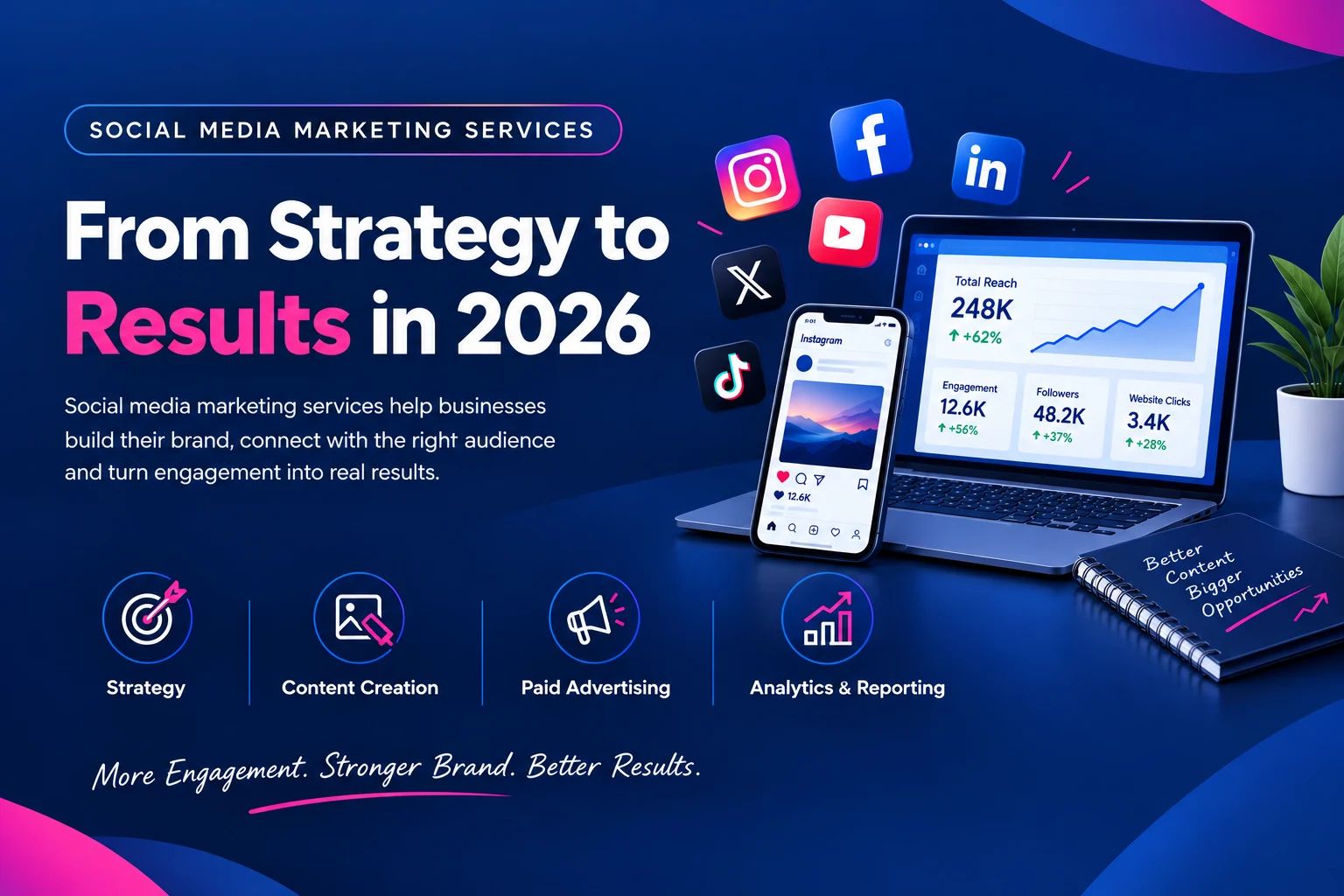
Businesses may plan, develop, post, manage, promote, and track their presence on social media sites like Facebook, Instagram, LinkedIn, YouTube, X, and Pinterest with the aid of social media marketing services. In order to support corporate objectives including exposure, engagement, and consumer inquiries, these services might involve social media planning, content production, scheduling, community management, paid advertising, influencer marketing, analytics, and lead generation.
Table of Contents
- What Are Social Media Marketing Services?
- Why Are Social Media Marketing Services Important?
- How Do Social Media Marketing Services Work?
- Key Elements of Social Media Marketing Services
- Social Media Marketing Services vs SEO vs Content Marketing
- Benefits of Social Media Marketing Services
- How to Choose Social Media Marketing Services
- Social Media Marketing Services Checklist
- 90-Day Social Media Marketing Study Plan
- Common Social Media Marketing Mistakes to Avoid
- Latest Social Media Marketing Trends in 2026
- Downloadable Social Media Marketing Resources
- Frequently Asked Questions
What Are Social Media Marketing Services?
Social media marketing services involve managing presence and activities across platforms such as Instagram, Facebook, LinkedIn, X, YouTube, Pinterest, and others. The goal is to enhance brand exposure, audience engagement, and overall business impact.
This process integrates various tasks and tools including content creation and management, audience growth, social media engagement, media buying, as well as performance measurement and analysis to drive effective brand development.
Such services generally comprise the following activities:
- Strategy development on the basis of business goals and audience research
- Content planning, design, copywriting, and video production
- Scheduling and publishing on social networks
- Replying to comments and messages (community management)
- Organizing paid social media advertising
- Tracking and analyzing results
Why Are Social Media Marketing Services Important?
- Nowadays, social media plays a critical role in creating initial impressions for nearly all businesses. A prospective client may visit the company’s website or contact the hotline, but before doing any of these things, he is most likely to check the company’s Facebook or Instagram page to see whether there are any clients and whether it is dependable.
- For this reason, businesses have to be considering the following advantages:
- Visibility: Active participation keeps a brand in front of those who have not decided yet whether they are going to buy something.
- Reliability: Maintained page shows that the company is really operating and paying attention to the needs of their audience.
- Discoverability: Particularly for young audiences, today Instagram and TikTok play the role of the discovery engine instead of the search engine.
- Direct contact: Direct messages and comments allow creating a kind of feedback.
- Lead generation: The company may target its ads at a very specific audience with help of social media.
- Parity: Inactive profile compared to the active competitor’s is considered less trustworthy even if it is not the case.
How Do Social Media Marketing Services Work?
Most engagements in professional circles run on a similar pattern of operations, although different tactics may apply in different sectors.
- Discovery and Audit – Identify the industry, audience, competition and existing social media presence.
- Strategizing and Goal Setting – Define success (awareness, engagement, leads and sales) and prioritize social media platforms.
- Content Planning – Develop a content calendar based on themes and campaigns.
- Content Creation – Create graphics, videos and write captions.
- Content Posting – Post at the right time when the audience is online, using scheduling systems.
- Community Management – Interact with posts through comments, messages and mentions.
- Social Media Advertising – Launch campaigns to boost reach beyond organic followers.
- Analysis and Reporting – Learn from mistakes and successes and adapt.
Key Elements of Social Media Marketing Services
Social Media Strategy – A document describing personas, voice, priorities, pillars, and measurable goals (growth in followers, engagement rate, leads generated).
Social Media Platform Selection – A company doesn’t need all social media platforms equally. A B2B software company will get more out of LinkedIn than Instagram. On the contrary, a fashion brand will benefit more from Instagram than from LinkedIn. The selection of social media should be driven by where the audience actually spends time and not the most popular place to be.
Content Creation – Graphics design, photography, videography, copywriting, and creating captions – the quality of this work forms first impressions about the brand.
Social Media Content Planning– A content calendar specifying what is going to be published, when and why – connected to campaigns, product launch, festivals, events within the industry, planned a long time in advance.
Social Media Posting and Scheduling -The process of publishing content at the right time using tools like Meta Business Suite, Later, Hootsuite, etc.
Community Management – Interaction with comments, DM, mentions, reviews – this is where a brand’s personality and quality of customer service are revealed.
Social Media Engagement – Proactive interaction with polls, questions, conversations – building two-way communication rather than broadcasting.
Hashtag Strategy – Research and use a mix of broad, narrow, and branded hashtags to increase visibility, especially important on Instagram and X.
Social Media Advertising – Paid campaigns on social media (Meta Ads, LinkedIn Ads) targeting demographics, interests, behavior, and retargeting, often a quickest way to generate leads.
Social Media Analytics and Reporting – Track reach, impressions, engagement rate, click-through rate, follower growth, conversions using native insights (Meta Business Suite, LinkedIn Analytics), as well as external tools (Sprout Social, Google Analytics).
Influencer Marketing – Collaboration with creators whose audiences are already interested and engaged, getting their trust through endorsements.
Social Media Branding – Consistent visual style, tone, and message across all social media channels.
Lead Generation Through Social Media – Lead-gen advertising formats, gated content, DM automation, calls to actions turning followers into leads and customers.
Social Media Optimization – Optimized bio, keywords, links, pinned posts, highlights making it easy for any new visitor to understand the offer.
Competitor Analysis– Analysis of competitive content performance.
Social Media Marketing Services vs SEO vs Content Marketing
| Aspect | Social Media Marketing | SEO | Content Marketing |
|---|---|---|---|
| Primary Goal | Engagement, brand awareness, community, leads | Organic search visibility and website traffic | Educating and nurturing audiences with valuable content |
| Main Platforms | Instagram, Facebook, LinkedIn, X, YouTube | Google, Bing search engines | Blogs, videos, guides, newsletters |
| Speed of Results | Faster visibility, especially with paid ads | Typically slower, builds over months | Medium-term; compounds over time |
| Content Lifespan | Short (hours to days, longer for video) | Long (can rank for years) | Long (evergreen potential) |
| Cost Structure | Organic + optional ad spend | Primarily time/effort + tools | Primarily time/effort + production cost |
| Best For | Brand awareness, community, direct engagement | Long-term organic traffic and authority | Building trust and supporting SEO/social |
Benefits of Social Media Marketing Services
- Increased brand recognition due to increased visibility of company’s content
- Improved customer relationships through engagement and feedback
- Enhanced understanding of the target audience through analytics and engagement data
- Cost-effective advertising than many other channels, when used correctly
- Increased customer support due to improved public image and transparency
- Complement to other marketing channels, such as SEO, email marketing and paid search advertising
- Ability to get real-time feedback on products and services
How to Choose Social Media Marketing Services
- Define your goals first. Awareness, engagement, leads, or sales – your goal should shape whom to hire.
- Examine portfolios and case studies. Look for something from your industry or similar to it, and inquire how realistic results could have been achieved.
- Ask questions related to strategies, not just implementation. A reputable provider explains why specific platforms and content are used in your business.
- Learn more about their reporting practices. Find out what kind of metrics are used and how often you will receive reports.
- Understand the pricing and scope of work. Define what services are included and what is priced separately (e.g., content development, ads budget management, community management).
- Find out more about their communication and turnaround time. Learn how to handle revision requests and other important issues.
- Begin with a trial period. Most businesses start with 1-3 months of cooperation.
- Avoid guarantees on achieving results. No reputable provider can guarantee a certain number of followers or the viral effect on their posts.
Social Media Marketing Services Checklist
- Defined target audience personas
- Clear brand voice and visual guidelines
- Optimized profile bios, links, and contact info on every platform
- Documented content pillars and themes
- Monthly or weekly content calendar
- Consistent posting schedule
- Mix of content formats (image, video, carousel, Reels/Shorts)
- Active community management (prompt comment/DM responses)
- Hashtag research and strategy in place
- At least one paid campaign structure tested
- Monthly analytics review with clear KPIs
- Competitor monitoring process
- Negative-comment response plan
- Clear CTA in relevant posts
- Quarterly strategy review
90-Day Social Media Marketing Study Plan
| Phase | Timeframe | Focus Areas | Key Activities |
| Phase 1: Foundation | Days 1–15 | Research & Setup | Audience research, competitor analysis, platform selection, profile optimization, brand voice guidelines |
| Phase 2: Planning | Days 16–30 | Strategy & Content Systems | Define content pillars, build a 30-day content calendar, set up scheduling tools, set KPIs |
| Phase 3: Execution | Days 31–50 | Content Production & Posting | Begin consistent posting, start community management routine, launch hashtag strategy |
| Phase 4: Paid Testing | Days 51–65 | Advertising | Launch first small-budget ad campaign, A/B test creatives and audiences |
| Phase 5: Optimization | Days 66–80 | Analysis & Refinement | Review analytics, double down on top-performing content, refine posting times |
| Phase 6: Scaling | Days 81–90 | Growth & Review | Expand successful formats, consider influencer collaboration, plan next quarter |
Common Social Media Marketing Mistakes to Avoid
- Posting without a strategy – random content rarely builds a coherent brand
- Inconsistent posting schedules – sporadic activity reads as a neglected brand
- Ignoring comments and messages – poor responsiveness damages trust quickly
- Chasing follower count over outcomes – vanity metrics don’t always translate to revenue
- Reposting identical content across platforms without adapting format or tone
- Neglecting analytics – without review, there’s no way to know what’s actually working
- Over-promoting without providing value – constant sales pitches tend to reduce engagement over time
- Skipping paid social entirely – organic reach alone is often limited for newer accounts
- Having no plan for negative feedback – poorly handled public complaints can escalate fast
Latest Social Media Marketing Trends in 2026
- AI-assisted content, human-edited before publishing. Tools like ChatGPT, Midjourney, and Canva’s AI features speed up drafts, but accounts still winning are the ones where a human edits for brand voice – unedited AI content is getting easier for audiences to spot and discount.
- Short-form video still drives reach, but pure trend-chasing is losing trust. Accounts blending trends with an original point of view are outperforming those copying formats one-for-one.
- Social search is a real competitor to Google for younger audiences, who search directly within Instagram and TikTok for recommendations – meaning bios, captions, and alt text now function like on-page SEO.
- Social commerce is maturing unevenly. In-app checkout works well for lower-consideration purchases (apparel, beauty, accessories) and less well for considered or high-ticket B2B sales.
- Micro and nano-influencers are outperforming celebrity endorsements on cost-per-engagement, especially for regional brands where local trust outweighs national reach.
- Personalized ad creative, not just targeting, is improving efficiency – multiple creative variants per segment tend to beat one creative shown broadly.
- Community-first formats (Close Friends, private groups, broadcast channels) are becoming genuine retention tools, not novelties.
- Social listening is informing product decisions, not just marketing copy – comments and DMs are treated as informal customer research.
- Platform-native content is rewarded over content that pushes users off-platform via external links.
- “Useful but imperfect” content is outperforming polished-but-empty content in engagement, particularly honest customer testimonials over heavily produced ads.
Downloadable Social Media Marketing Resources
Social Media Marketing Starter Checklist:
- Audience persona document
- Competitor analysis spreadsheet
- Brand voice and visual style guide
- Content pillars document (3–5 pillars)
- Monthly content calendar template
- Hashtag research list (broad, niche, branded)
- Posting schedule by platform
- Community management response guidelines
- Monthly analytics report template
- Quarterly strategy review checklist
Frequently Asked Questions
1. What are social media marketing services?
Social media marketing services help businesses manage and grow their presence on platforms such as Instagram, Facebook, LinkedIn, YouTube, and X through strategy, content creation, engagement, advertising, and analytics.
2. Why are social media marketing services important for businesses?
They help businesses improve online visibility, connect with their target audience, build brand awareness, engage customers, and generate potential leads through organic and paid social media activities.
3. What do social media marketing services include?
They can include social media strategy, content creation, content planning, posting and scheduling, community management, hashtag research, paid advertising, analytics, influencer marketing, and competitor analysis.
4. How do social media marketing services help generate leads?
Businesses can generate leads through targeted social media ads, lead forms, website links, promotional content, direct messages, and clear calls to action that encourage users to enquire or take the next step.
5. How much do social media marketing services cost?
The cost varies depending on the number of platforms, content requirements, community management, advertising, reporting, and the scope of services. Businesses should compare pricing based on the actual deliverables included.
