
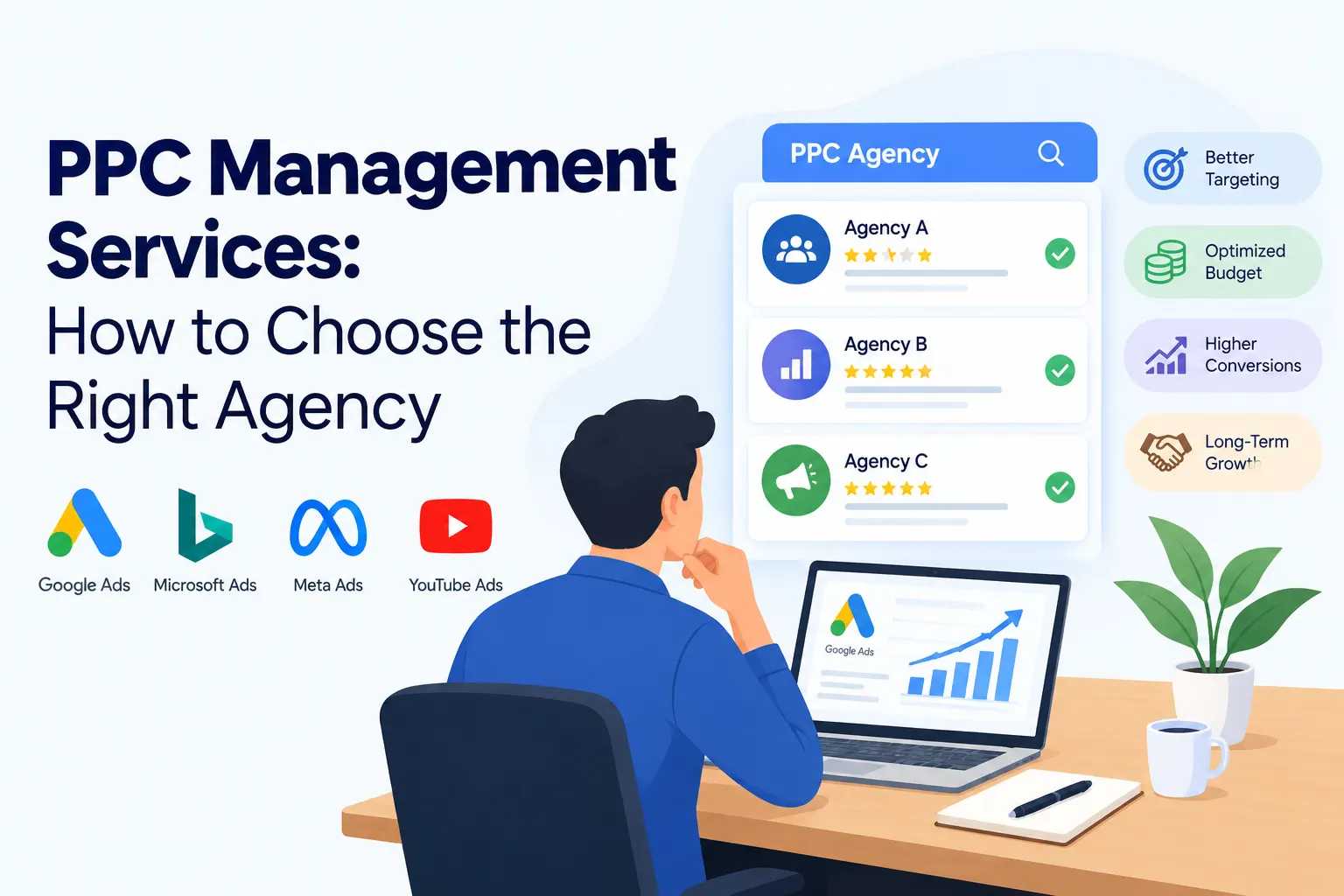
Quick Answer: Hiring a professional or agency to design, manage, and enhance your pay-per-click advertisements on sites like Google Ads and Meta is known as PPC management services. Keyword research, ad production, targeting, budget management, conversion monitoring, and reporting are all handled by a competent firm. No one can genuinely guarantee leads or sales, and their charge is independent of your advertising budget.
Introduction: Why PPC Management Services Matter
You’re not the only one who has invested in Google Ads and seen the budget go with no return on investment. One of the most quantifiable methods to connect with customers who are actively looking for your products is through pay-per-click (PPC) advertising. Additionally, when campaigns lack a clear plan, it’s one of the simplest ways to lose money.
For this reason, a lot of companies seek out PPC management services. PPC rewards consistent attention—keyword research, testing, tracking, budget control, and truthful reporting—not because it’s hard to learn.
You will discover what a PPC management agency does, how pricing models operate, how an agency differs from an internal setup, and how to evaluate a PPC agency step-by-step in this guide to PPC management services. A hypothetical case study, checklists, a 90-day plan, and answers to frequently asked questions are also included.
Before we begin, let’s be clear: no agency can promise leads, sales, or rankings. Your market, budget, offer, website, and the effectiveness of your campaigns all affect the outcome. Before you sign anything, a good partner will let you know that.
What Are PPC Management Services?
PPC management services involve a specialist or agency organizing, setting up, and continuously optimizing pay-per-click advertising campaigns. In order to ensure that your ad spend is focused on quantifiable business objectives rather than conjecture, they usually cover keyword research, ad creation, audience targeting, bidding, budget control, conversion tracking, and reporting.
An auction model underpins pay-per-click advertising. You make ads, bid on audiences or keywords, and (usually) pay when a click is made. Bids, ad relevance, and landing page quality are some of the criteria used by platforms like Google Ads and Microsoft Advertising to determine which ads show up.
The day-to-day operation of such a system is handled by a PPC management firm, also known as a PPC agency or PPC management company. In actuality, that typically consists of:
- Campaign planning: Turning your business goals into a campaign structure.
- Keyword research: Finding the search terms your customers actually use.
- Ad creation: Writing and testing ad copy and creative.
- Audience targeting: Reaching the right people by location, intent, interests, or past behavior.
- Bidding and budget management: Controlling how and where money is spent.
- Conversion tracking: Measuring calls, form fills, purchases, or other valuable actions.
- Performance reporting: Explaining what happened, why, and what to do next.
Think of it as the difference between owning a car and having a skilled driver who also watches the fuel gauge.
Why Are PPC Management Services Important for Businesses?
From the outside, PPC appears straightforward: choose keywords, create an advertisement, and establish a budget. A few weeks later, when search keywords shift, rivals alter their offers, and you discover no one has verified the quality of the leads, the problems begin.
Professional campaign management can help businesses:
- Structure campaigns so the budget goes to the offers and locations that matter most.
- Monitor spending and catch wasted clicks early.
- Test advertisements in an organized way instead of changing things randomly.
- Identify opportunities such as new keywords, audiences, or underused platforms.
- Improve campaign efficiency by reviewing search terms, placements, and conversion data regularly.
This is the point that many agencies overlook: many factors affect the outcome than just the account manager. Competition, financial constraints, landing page quality, your offer, targeting, and the effectiveness of the plan’s execution are all important factors. Even a brilliant campaign will fail if it directs users to a slow, confused page. The odds are increased by good management. It does not take the place of a strong business proposal.
What Does a PPC Management Agency Do?
Here’s what pay-per-click management looks like in practice, with simple examples.
PPC Keyword Research
Understanding what people type when they’re prepared to act—rather than just what receives the most searches—is the goal of keyword research. “CRM software” is an example of a curious phrase. “CRM software for small real estate teams in Pune” implies a decision-maker.
In order to prevent you from paying for unnecessary searches, an agency organizes terms by intent, calculates competition, and creates a negative keyword list (for instance, omitting “free” or “jobs” if you sell services).
Campaign Strategy and Planning
The agency should map objectives to structure before any advertisement goes online. This entails choosing the campaign kinds to employ, allocating funds, prioritizing locations and devices, and determining what constitutes a good outcome.
For instance, a software company is looking for requests for demos. Branded searches, high-intent product searches, and competitor-comparison searches might all have their own budget and landing page in the strategy.
Google Ads Campaign Management
The majority of Google Ads management services revolve around this. Building search, display, shopping, video, and other campaign types in Google Ads is part of it, as is tracking bids, budgets, ad groups, extensions (assets), and search phrases over time.
Automation, particularly Smart Bidding, is a major component of modern Google Ads. Advertisers should designate their significant conversions as “Primary” in order for Smart Bidding to target them, according to Google Ads Help. That serves as a helpful reminder that automation is only as intelligent as the data it is fed. Instead of merely turning on automated features, skilled management entails defining the proper objectives and monitoring the outcomes.
Microsoft Advertising Management
Reaching users that search on Bing and its partner network is possible with Microsoft Advertising. It won’t work for every company because audience size and cost differ by nation and industry. Campaigns may frequently be imported from Google Ads and subsequently modified, making it a helpful alternative channel for some advertisers. You can determine if testing is worthwhile with the assistance of an agency.
Paid Social Advertising
Search and paid social media (like Meta’s Facebook, Instagram, LinkedIn, and others) operate differently. Since people are scrolling rather than searching, audience targeting and creativity are more important.
For instance, a B2B company could favor LinkedIn targeting by job function, but a local fitness studio might utilize Instagram advertisements with brief videos and a location-based audience. Verify the platform’s current features as available targeting options are subject to change.
Ad Copy and Creative Development
Ad copy must be truthful, precise, and consistent with the landing page. Before it becomes stale, an agency should test several headlines and descriptions, take note of the outcomes, and update the creative. Images, brief movies, and format-specific designs are included for display, video, and social media.
Audience Targeting and Remarketing
By using audience targeting, you can limit who sees your advertisements. Those who have previously visited your website or engaged with your company are reached by remarketing. A visitor who saw a pricing page but did not make an inquiry is a completely different audience than someone who has never heard of you, and they should receive different messaging.
A competent agency keeps abreast of privacy regulations and platform standards because they have an impact on audience building.
Landing Page and Conversion Optimization
Clicks are expensive. Whether or whether that money was spent wisely depends on what happens following the click. Page speed, mobile layout, message alignment with the advertisement, form length, trust signals, and call-to-action clarity are all frequently examined by agencies.
For instance, if your advertisement offers a “free consultation,” the landing page should provide a clear method of scheduling one rather than a generic webpage.
Conversion Tracking and Analytics
You’re speculating without tracking. Typically, agencies link platforms like Google Ads with analytics tools like Google Analytics 4 and set up conversion actions for form submissions, calls, purchases, or other significant events.
Additionally, they must look for low-quality or duplicate conversions. Counting each page view as a “conversion” results in impressive statistics and poor choices.
Campaign Monitoring and Reporting
Budget pacing, search term evaluations, ad performance, and anomalous changes are all continuously monitored. Clear and simple language characterizes good reporting. It ought to respond to: What did we get, what did we learn, how much did we spend, and what are we going to change next?
Types of PPC Advertising Campaigns
The objectives of various campaign types vary. Use this chart as a starting point because platform features and availability may differ by nation and change over time.
| Campaign Type | Best For | Things to Keep in Mind |
| Google Search Ads | Capturing people actively searching for your product or service; lead generation | Often high intent, but keywords can be competitive |
| Google Display Ads | Awareness and remarketing across websites and apps | Usually less direct intent than search; placement quality needs monitoring |
| Shopping Ads | Ecommerce businesses with product catalogs | Requires a clean product feed and merchant account setup |
| YouTube Ads | Brand awareness, product demonstrations, storytelling | Needs strong video creative; measurement may focus on views and assisted conversions |
| Microsoft Advertising | Extending search reach on Bing and partner networks | Audience and volume differ by market |
| Facebook and Instagram Ads | Demand generation, local promotion, ecommerce, remarketing | People aren’t searching, so creative and offer carry more weight |
| Remarketing Campaigns | Re-engaging past visitors, abandoned carts, or leads that stalled | Needs enough audience size; frequency should be controlled |
Most companies don’t require every kind of marketing; a small-budget startup can begin with search and add others once tracking and landing pages are operational.
PPC Management Services vs In-House PPC Management
There’s no universal winner. The better choice depends on your resources, goals, and how complex your campaigns are.
| Factor | PPC Agency | In-House Team |
| Cost structure | Management fee (monthly, percentage, or project-based) plus ad spend | Salary, benefits, tools, training, plus ad spend |
| Expertise | Exposure to multiple industries and platforms | Deep knowledge of your own business |
| Campaign control | Shared; depends on agreed access and approvals | Full day-to-day control |
| Time requirements | Lower internal time, though you still need to review and give feedback | Significant internal time for management and learning |
| Access to specialists | Often includes strategists, analysts, and creatives | Limited to who you hire |
| Reporting | Usually structured and scheduled | Depends on team skills and tools |
| Scalability | Easier to scale scope up or down | Scaling requires hiring and training |
| Best suited for | Businesses without PPC expertise or with growing complexity | Larger businesses with steady ad budgets and dedicated marketing staff |
Many companies land on a hybrid model: an in-house marketer owns strategy and brand knowledge, while an agency handles execution or specialist tasks.
Benefits of Hiring a PPC Management Agency
A good agency can offer real advantages:
- Specialist expertise: People who work in ad accounts daily tend to spot patterns and platform changes faster.
- Structured testing: Ads, audiences, and landing pages are tested methodically, not by gut feeling.
- Budget monitoring: Regular reviews help limit wasted spend.
- Conversion tracking: Proper setup connects ad activity to business outcomes.
- Campaign optimization: Ongoing adjustments based on data rather than set-and-forget.
- Reporting: Clear updates that help you make decisions.
Limitations to keep in mind: Performance is not always improved by employing an agency. Unrealistic expectations, a slow website, or a poor offer cannot be fixed by an agency. Additionally, it adds a management fee to the cost of advertisements, which some companies with extremely tight budgets could find difficult to justify. Anyone who makes explicit promises should be avoided.
How Much Do PPC Management Services Cost?
The cost of PPC management varies significantly depending on the location, size of the agency, industry, scope, and number of platforms used. Here’s how pricing is typically organized rather than using figures that would become outdated.
PPC management services are often charged as an hourly consultation cost, a fixed project fee, a monthly fee, or a percentage of ad spend. Your advertising budget, which is paid directly to platforms like Google, does not include the agency’s cost. Because pricing varies by market, scope, and account complexity, always request a documented breakdown.
| Pricing Model | How It Works | Works Well When | Watch Out For |
| Monthly management fee | Flat fee for ongoing management | You want predictable costs and a defined scope | Make sure deliverables are written down |
| Percentage of ad spend | Fee is a share of your monthly budget | Budgets are large and scaling | Fees rise as spend rises, regardless of workload |
| Fixed project fee | One-time price for setup, an audit, or a defined project | You need a launch, audit, or restructure | Doesn’t cover long-term optimization unless agreed |
| Hourly consulting | Pay for time used | You need advice or training for an in-house team | Costs can grow without a clear scope |
| Custom pricing | Tailored mix of the above | Complex or multi-platform needs | Needs very clear documentation |
Management fee vs ad budget: These are two distinct expenses. Google, Microsoft, or Meta receive the money you spend on advertisements. The cost of the agency’s time and experience is covered by the fee. Verify whether taxes like GST are applicable in your market and how the advertising budget will be paid (straight from your card or account, or through the agency).
Be cautious if an agency gives you a quote during a first conversation without knowing your objectives. Actual information is necessary for actual pricing.
How to Choose the Right PPC Management Agency
Establish your objectives, make a short list of platforms, look over pertinent case studies and experience, and inquire about how the PPC firm will monitor conversions and report outcomes. Next, agree on reasonable KPIs, define pricing, and verify that you are the owner of your ad accounts. A good agency never guaranties outcomes and provides a clear explanation of its approach.
Here’s the process in detail.
- Define your business goals – Be specific. “More leads” is vague. “Qualified enquiries from Delhi NCR at a cost our sales team can afford” is something an agency can plan around.
- Identify the right advertising platforms – Search ads may suit high-intent services. Ecommerce may need Shopping. Visual brands may lean on paid social. Let your customers’ behavior guide this, not trends.
- Review the agency’s experience – Look for relevant industry or business-model experience, platform knowledge, and a team that explains things clearly. Check whether the agency actually holds the certifications or partner status it claims.
- Examine case studies and references – Ask for examples similar to your situation, and speak to a past client if possible. Be cautious with case studies that show impressive results without context such as budget, timeframe, or goals.
- Understand the proposed strategy – Ask them to explain, in plain language, what they’d do in the first 30, 60, and 90 days and why.
- Ask about conversion tracking and reporting – How will they measure leads, calls, or sales? Can they separate quality leads from junk? How often will you get reports, and what will be in them?
- Clarify fees and advertising budgets – Get a written scope covering management fees, setup costs, ad budget handling, and what happens if you want to change or stop.
- Confirm account ownership and access – Your ad accounts, data, and tracking should belong to you. You should have admin or at least full-visibility access at all times.
- Review communication and support – Who is your point of contact? How quickly do they respond? How are decisions and changes shared?
- Establish realistic KPIs and expectations – Agree on the metrics that matter (cost per lead, conversion rate, ROAS, lead quality) and on what a reasonable testing period looks like. Learning takes time, and rushed judgments help no one.
Questions to Ask Before Hiring a PPC Agency
Bring this list to your first conversations:
Experience
- Have you worked with businesses like mine, in my market and budget range?
- Who will actually manage my account, and how many accounts do they handle?
Campaign setup
- What would your first 30 days look like?
- How do you decide which keywords, audiences, and campaign types to start with?
Reporting and tracking
- How will you set up and verify conversion tracking?
- How often will we get reports, and can I see the live account anytime?
- How do you handle lead quality, not just lead volume?
Budget allocation
- How do you recommend splitting the budget across campaigns or platforms?
- How do you handle budget changes mid-month?
Account ownership
- Will I own the ad accounts, analytics, and tracking assets?
- What happens to the accounts if we stop working together?
Optimization process
- How often do you review search terms, ads, and bids?
- How do you test changes without disrupting performance?
Contract terms
- Is there a minimum contract length or notice period?
- Are there setup fees, creative fees, or other extras?
- What does the agreement say about ad spend, refunds, and responsibilities?
PPC Management Checklist
Use this checklist for your own campaigns or to review an agency’s work.
Campaign objectives
- Primary goal defined (leads, sales, calls, sign-ups)
- Target cost per lead or ROAS discussed and documented
- Lead or sale quality criteria defined
Keyword research
- Keywords grouped by search intent
- Branded and non-branded terms separated
- Match types chosen deliberately
Audience targeting
- Locations, languages, and devices set intentionally
- Remarketing audiences created where appropriate
- Audience exclusions reviewed
Campaign structure
- Campaigns organized by goal, product, or service
- Ad groups tightly themed
- Budgets assigned per campaign
Ad copy
- Multiple ad variations running
- Messaging matches the landing page
- Claims are accurate and policy-compliant
Landing pages
- Fast and mobile-friendly
- One clear call to action
- Form or checkout tested end to end
Conversion tracking
- Key conversion actions set up and verified
- Important conversions marked correctly for bidding
- No duplicate or irrelevant conversions counted
Budget allocation
- Daily and monthly budgets reviewed
- Spend shifted toward better-performing areas based on data
Negative keywords
- Starter negative list added
- Search terms report reviewed on a regular schedule
Performance monitoring
- Weekly checks for spend, errors, and anomalies
- Disapproved ads and policy issues reviewed
Reporting
- Monthly report includes spend, results, and lessons
- Lead quality feedback shared between sales and marketing
Ongoing testing
- One test at a time with a clear hypothesis
- Results documented and reused
PPC Management for Small Businesses and Startups
Smaller businesses can absolutely use PPC. The key is to be focused, not to spread thin.
- Start narrow. One service, one location, and a handful of high-intent keywords beat a broad launch.
- Set realistic goals. Aim to learn what works before scaling. Early weeks are often about gathering data.
- Keep tracking simple but accurate. Even a basic setup tracking form fills and calls is far better than none.
- Protect your budget. Use negative keywords, location targeting, and tight ad schedules where it makes sense.
- Fix the basics first. A clear offer and a fast, mobile-friendly landing page often matter more than clever bidding.
A practical hypothetical example: Consider a low monthly budget for a small tutoring firm in a single city. Rather than using general awareness advertisements, it might start a single search campaign for “maths tutor for class 10 near me” type queries, direct users to a specific page with a straightforward booking form, include negatives like “free” and “jobs,” monitor form submissions, and review the search keywords every week. It would examine which questions generated actual inquiries after a few weeks and provide funds to those. This is not a forecast of results; it is merely an example of a method.
Sometimes a one-time audit or consulting agreement makes more sense than full management for extremely tiny expenditures. Find out whether agencies provide it.
Common PPC Management Mistakes to Avoid
- Choosing keywords without understanding search intent – Not every search means “ready to buy.” Match keywords to what the person actually wants.
- Ignoring negative keywords – Without them, irrelevant searches can quietly drain the budget.
- Sending traffic to irrelevant landing pages – If the page doesn’t match the ad, visitors leave.
- Failing to configure conversion tracking – You can’t improve what you can’t measure.
- Making frequent changes without enough data – Constant tweaking can disrupt learning and make results impossible to interpret.
- Ignoring mobile user experience – Many users will see your ad on a phone. Test how it feels there.
- Spending without clear objectives – A budget without goals is just spending.
- Evaluating performance using clicks alone – Clicks aren’t customers. Look at conversions and lead quality.
- Failing to review search terms and reports – Regular reviews uncover waste and new opportunities.
- Expecting immediate guaranteed results – PPC can generate traffic quickly, but efficient performance usually takes testing and refinement.
Important PPC Metrics Every Business Should Understand
Numbers only help if you know what they mean. Here are the core metrics, and when each one is useful.
| Metric | What It Means | When It’s Useful |
| Impressions | How many times your ad was shown | Checking reach and visibility, especially for awareness campaigns |
| Click-through rate (CTR) | Clicks divided by impressions | Judging how relevant and appealing your ad is to searchers |
| Cost per click (CPC) | Total cost divided by clicks | Understanding traffic cost and keyword competitiveness |
| Conversion rate | Conversions divided by clicks (or interactions) | Checking whether your landing page and offer turn visitors into leads or buyers |
| Cost per conversion | Total cost divided by conversions | Comparing campaigns when conversion actions are similar in value |
| Cost per acquisition (CPA) | Cost of acquiring a customer or a specific target action | Setting a sustainable limit for lead or customer cost |
| Return on ad spend (ROAS) | Conversion value divided by ad spend | Ecommerce and any business that tracks revenue per conversion |
| Return on investment (ROI) | Profit gained relative to total cost, including fees and other costs | Seeing the bigger business picture beyond the ad platform |
A quick caution: cost per conversion and CPA are sometimes used interchangeably, but definitions can differ by platform and by business. Agree on exactly what each term means in your reports.
How to Measure PPC Campaign Performance
Measuring PPC well is less about staring at dashboards and more about asking the right questions in the right order.
- Define your goals. Decide what success looks like: qualified leads, sales, booked calls, app installs. Write down a target cost or return that makes sense for your margins.
- Set up conversion tracking. Track the actions that matter (form submissions, phone calls, purchases) and verify they fire correctly. Test them yourself.
- Establish a baseline. Before judging improvement, record starting numbers for spend, CTR, conversion rate, and cost per conversion. If you don’t have history, treat the first few weeks as a learning baseline.
- Review campaign data regularly. Look at campaigns, ad groups, search terms, devices, locations, and audiences. Look for patterns, not one-day swings.
- Test changes carefully. Change one meaningful thing at a time where possible, and give it enough data before deciding.
- Report results clearly. Share what happened, what you learned, and what comes next, in plain language.
Why lead quality matters: A campaign that delivers 100 leads that never answer the phone isn’t better than one that delivers 20 serious enquiries. Connect ad data with sales feedback so you know which keywords, audiences, and ads bring in real business. Clicks and impressions are signals along the way. Actual business outcomes are the destination.
Hypothetical PPC Management Case Study
Important: This is a hypothetical example created for illustration. It is not a real client result. All numbers are illustrative assumptions, not benchmarks or promises.
Business type: A boutique interior design studio serving homeowners in one metro area.
Initial advertising challenges:
- The studio ran broad Google Ads campaigns with a single ad group and sent everyone to the homepage.
- Search terms included many irrelevant queries (DIY ideas, free templates, job seekers).
- Form submissions were tracked, but phone calls weren’t, and the team couldn’t tell which enquiries were serious.
Campaign strategy: Separate campaigns for high-intent service searches, a smaller branded campaign, and a remarketing audience for past site visitors. Budget focused on the studio’s service area only.
Keyword and audience selection: Specific phrases such as “full home interior designer” and “modular kitchen design” in the target city, with negatives for “free,” “DIY,” “course,” and “jobs.” Location targeting limited to areas the studio actually serves.
Landing page improvements: A dedicated page for each service with project photos, a short enquiry form, a click-to-call button, and clear next steps. The page was checked for mobile speed and layout.
Conversion tracking: Form submissions and call clicks were set up as separate conversion actions, then reviewed together with the sales team’s notes on enquiry quality.
Metrics monitored: Cost per enquiry, conversion rate, qualified-enquiry rate, search term quality, and share of budget spent in the target area.
Illustrative results (assumed figures only):
| Metric | Before (assumed) | After 90 days (assumed) |
| Monthly ad budget | 60,000 (INR) | 60,000 (INR) |
| Clicks | 1,800 | 1,500 |
| Enquiries | 18 | 45 |
| Conversion rate | 1% | 3% |
| Cost per enquiry | about 3,333 | about 1,333 |
| Qualified enquiries | 4 | 16 |
Lessons learned (in this imagined scenario):
- Fewer clicks can still mean better results when they’re better targeted.
- Tracking calls as well as forms changed the picture of what was working.
- Landing page changes mattered as much as keyword changes.
- Sales feedback made the reporting far more useful than platform data alone.
In real campaigns, results vary widely, and some accounts need more time, more data, or a different approach.
Expert Tips for Better PPC Campaign Management
These come from the kind of habits that tend to separate steady accounts from messy ones.
- Keep your structure clean – Group keywords by theme and intent. A tidy account is easier to test and easier to fix.
- Target intent before volume – A smaller number of the right searches usually beats a large number of vague ones.
- Make ads match the search – If someone searches a specific service, the ad and landing page should talk about that service.
- Treat landing pages as part of the campaign – Page speed, clarity, trust signals, and a simple form often move results more than another bid tweak.
- Audit tracking regularly – Tags break when websites change. Test conversions after every website update.
- Feed automation good data – Smart Bidding and similar features depend on accurate conversion signals, so be careful about which actions you count as important.
- Allocate budget by evidence. Shift money toward what’s working, but give new campaigns a fair learning period.
- Test with intention. Write down what you changed, why, and what you expect. Otherwise, you’ll forget what you learned.
- Review search terms often. It’s one of the fastest ways to cut waste and find new keyword ideas.
- Share quality feedback. Tell your agency which leads were good and which weren’t. That feedback is gold.
90-Day PPC Campaign Improvement Plan
Timelines and results vary by campaign, industry, budget, and the data available. Use this as a flexible framework, not a promise.
| Time Period | Key Activities | Expected Deliverables | Performance Metrics |
| Days 1-14: Research and audit | Review goals, existing accounts, website, competitors, and current tracking; keyword and audience research | Audit summary, keyword plan, tracking plan, agreed goals | Baseline data, tracking accuracy, account health |
| Days 15-30: Setup and launch | Build campaigns, write ads, create or improve landing pages, verify conversion tracking, set budgets | Live campaigns, tested tracking, reporting dashboard | Impressions, CTR, early conversion tracking |
| Days 31-60: Testing and learning | Review search terms, add negatives, test ad variations, adjust targeting, check landing page behavior | First performance review, test log, updated keyword and ad plans | CTR, conversion rate, cost per conversion, lead quality feedback |
| Days 61-90: Optimization and scale decisions | Refine budgets and bids, expand what works, pause what doesn’t, explore remarketing or other channels | Optimization report, recommended next-quarter plan | CPA, ROAS (if applicable), qualified lead rate |
| Ongoing | Monthly reporting, regular testing, quarterly strategy review | Monthly reports, strategic recommendations | Trends over time, business outcomes |
Final Thoughts: Choose a PPC Partner You Can Trust
Effective PPC doesn’t involve cunning tactics. It involves a well-defined plan, a prudent budget, precise monitoring, and consistent optimization based on actual data. The ideal PPC management company assists you in executing those tasks effectively, explains its work, and maintains integrity when it takes longer to see results.
Clearly define your objectives, monitor your progress, and weigh your options using the questions and checklist in this guide before hiring anyone.
Are you prepared to manage your advertising budget? Discuss your objectives and ongoing campaigns with Blix Technologies. As an AI-driven digital marketing firm that offers Google Ads, Meta Ads, and SEO, we can assist you in determining whether PPC management services are appropriate for your company and what a smart first step entails.
Frequently Asked Questions
1. What are PPC management services?
Your pay-per-click advertising, including keyword research, ad creation, targeting, bidding, budget management, conversion tracking, and reporting across platforms like Google Ads, Microsoft Advertising, and social networks, is planned, executed, and optimized by a specialist or agency.
2. What does a PPC management agency do?
A PPC management company creates and oversees your campaigns, tests advertisements, keeps an eye on your spending, examines search phrases, establishes tracking, and provides results. Additionally, several offer guidance on landing pages and the integration of paid advertisements with SEO and other marketing strategies.
3. How much do PPC management services cost?
Market, scope, and complexity all matter. Common arrangements include hourly consulting, fixed project fees, monthly payments, and a share of ad expenditure. Remember that the cost of the agency is not included in your advertising budget. Ask for a formal quote based on your goals.
4. Are PPC services for small businesses worth it?
If the offer, goals, and budget are reasonable, they can be. Full management is advantageous for certain small organizations. Others benefit more from consultancy, training, or audits. Determine the appropriate degree of support by comparing the management fee to your realistic ad budget.
5. What is the difference between PPC and SEO?
PPC, or pay-per-click (PPC) advertising, allows exposure to begin as soon as a campaign is authorized and operational. Through content, technical quality, and authority—all of which typically require more time to develop—SEO achieves organic rankings. Since they support various stages of growth, many businesses use both.
6. How do I choose the right PPC agency?
Establish your objectives, look out relevant experience and references, find out how they will track and report, comprehend fees, make sure you will be the account owner, and decide on reasonable KPIs. View the above step-by-step procedure.
7. Which advertising platforms do PPC agencies manage?
Google Ads, Microsoft Advertising, Meta (Facebook and Instagram), LinkedIn, YouTube, and other platforms are frequently used. Inquire about the platforms that an agency actually uses, not just the ones it lists.
8. How long does PPC campaign optimization take?
The timeline is not set in stone. Campaigns can begin sending traffic shortly after launch, but obtaining sufficient data is typically necessary for significant optimization. Low-volume accounts may require more time. Optimization is an ongoing process rather than a one-time event.
9. Which metrics should businesses track in PPC campaigns?
Monitor lead quality as well as impressions, CTR, CPC, conversion rate, cost per conversion, CPA, ROAS, and ROI. A single statistic is insufficient to provide a complete picture. Select the ones that relate to your company’s objectives.
10. What is included in a PPC management package?
Although packages differ, they frequently include bid and budget management, account setup or audit, keyword research, ad creation, conversion tracking, optimization, and frequent reporting. Ask for the scope in writing at all times, and make it clear what is additional (such landing pages or creative production).